
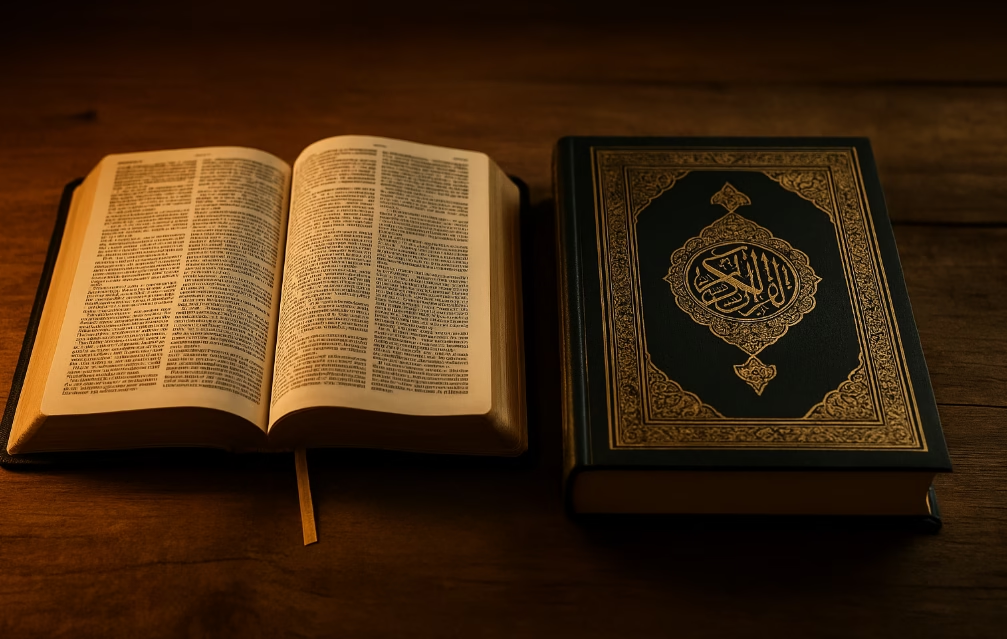
Before discussing manuscript evidence or history, let’s start right where the Muslim argument self-destructs: the Qur’an itself.
The Qur’an commands Muslims to believe in the Torah (Old Testament) and the Gospel (New Testament):
Surah 5:46–47 — “We sent Jesus, the son of Mary, confirming the Torah that had come before Him, and We gave Him the Gospel… Let the people of the Gospel judge by what Allah has revealed therein.”
Surah 3:3–4 — “He has revealed to you the Book with truth, confirming what was before it. And He revealed the Torah and the Gospel before, as guidance for mankind.”
Surah 10:94 — “If you are in doubt about what We have revealed to you, then ask those who have been reading the Scripture before you.”
These are not obscure verses. They are clear commands.
In Muhammad’s own lifetime (7th century A.D.), the Qur’an affirmed that the Scriptures of the Jews and Christians were genuine and trustworthy.
Now ask this simple question:
If the Bible had been corrupted before Muhammad, why would the Qur’an tell people to believe in it and consult it for truth?
That would mean Allah was instructing His followers to trust a corrupted book — which would make Allah either deceptive or ignorant.
Neither is possible under Islamic theology.
Thus, if the Qur’an is true, then the Bible was still pure and reliable in the 7th century.
And since we have biblical manuscripts hundreds of years older than that — manuscripts that say exactly the same thing we read today — the “corruption” claim falls apart completely.
2. “Rewritten” Is Not “Corrupted” — Understanding Transmission
Muslims often say “the Bible was rewritten,” but that’s a misunderstanding of how Scripture was transmitted and translated.
The Bible has been copied, not rewritten — and that’s an important distinction.
We have:
-
Over 5,800 ancient Greek manuscripts of the New Testament,
-
Over 10,000 Latin copies,
-
And over 9,000 early translations in other languages.
When you compare these manuscripts, the differences are mostly minor — punctuation, spelling, or word order — none of which change a single major doctrine.
In fact, scholars can reconstruct the original text with over 99% accuracy.
This is what real preservation looks like: open transmission and verifiable consistency.
Now contrast that with how the Qur’an was handled historically.
3. The Qur’an Was “Preserved” by Burning Its Variants
Muslims love to claim that the Qur’an has never been changed, but their own historical sources say otherwise.
According to Sahih al-Bukhari (4987) — one of Islam’s most trusted hadiths — Caliph Uthman ibn Affan ordered that all other Qur’anic manuscripts be burned, except one standardized copy.
Why? Because multiple Qur’ans were circulating with differences in wording and recitation.
These weren’t minor pronunciation issues; they involved different readings, structures, and meanings — known today as the seven ahruf and ten qira’at (recitations).
That means Islam’s “perfect preservation” came through centralization and censorship, not through divine protection.
Meanwhile, the Bible’s textual history is transparent and public, allowing anyone to examine thousands of surviving manuscripts across languages and centuries.
4. The Bible’s Diversity Proves Its Authenticity
Unlike the Qur’an, the Bible wasn’t dictated by one man claiming private revelation.
It was written by around 40 different authors over 1,500 years, in three languages (Hebrew, Aramaic, and Greek), across three continents, yet it tells one consistent story: the redemption of humanity through Jesus Christ.
That is supernatural unity — not corruption.
God didn’t need to hide His Word behind one language or one man.
He revealed it through prophets, apostles, kings, fishermen, and witnesses — and then let history test it.
That’s the mark of authenticity.
5. The Double Standard: Trusting Islamic Scribes but Not Biblical Ones
When Muslims claim,
“The Bible was copied by men, therefore it’s corrupted,”
ask this in return:
“Then how did the Qur’an get copied — by angels or by men?”
Both were copied by human hands.
If Muslims trust their scribes but not ours, that’s a double standard, not a rational argument.
6. The Qur’an Recognizes Jesus — But Stops Short of the Truth
Even the Qur’an acknowledges that Jesus was born of a virgin, performed miracles, and is “the Word of God” (Surah 3:45).
Yet it denies His divinity and crucifixion — the very core of the Gospel message.
That’s where Islam breaks down spiritually.
The Qur’an recognizes the man, but the Bible reveals the Messiah.
As Jesus Himself said:
“You search the Scriptures because you think they give you eternal life. But the Scriptures point to Me.”
— John 5:39
7. Historical and Archaeological Evidence
Beyond theology, the Bible is anchored in verifiable history.
Archaeology consistently confirms biblical locations, names, and events:
-
The Pool of Bethesda (John 5:2) has been found.
-
The inscription of Pontius Pilate (Matthew 27) was discovered in Caesarea.
-
The Dead Sea Scrolls confirm the Old Testament’s accuracy — matching the same text we read today.
Meanwhile, no original manuscript of the Qur’an exists, and the earliest copies differ from today’s Hafs version.
That’s not divine preservation — that’s human editing.
8. The Gospel’s Message Can’t Be Corrupted
Even if hypothetically every manuscript disappeared, the Gospel message would still stand — because it lives in the hearts, testimonies, and lives of believers across centuries.
You can destroy paper, but not the Spirit of Truth.
Jesus said:
“Heaven and earth will pass away, but My words will never pass away.”
— Matthew 24:35
The same God who raised Christ from the dead is perfectly capable of preserving His Word.
Conclusion: The Real Issue Is the Source of Truth
The Islamic argument that “the Bible has been rewritten” fails historically, logically, and theologically.
It’s not supported by textual evidence — and it directly contradicts the Qur’an itself.
The real issue isn’t which book had fewer scribes — it’s which revelation leads you to the truth about Jesus Christ.
The Bible points directly to Him as Lord, Savior, and Son of God.
The Qur’an only points halfway — acknowledging Him, but denying His divinity and sacrifice.
“The Qur’an recognizes the man.
The Bible reveals the Messiah.”
And that’s the difference between religion and relationship — between reciting verses and knowing the living Word of God.
Final Call
If you’re a Muslim reading this, know this:
You don’t need to fear the Bible — you need to read it.
The same God you believe created heaven and earth is calling you to know His Son, Jesus Christ.
He is not just a prophet.
He is the Way, the Truth, and the Life (John 14:6).
And He offers forgiveness, not through rituals, but through His blood.
Related
Discover more from Christ Reigns Media
Subscribe to get the latest posts sent to your email.