
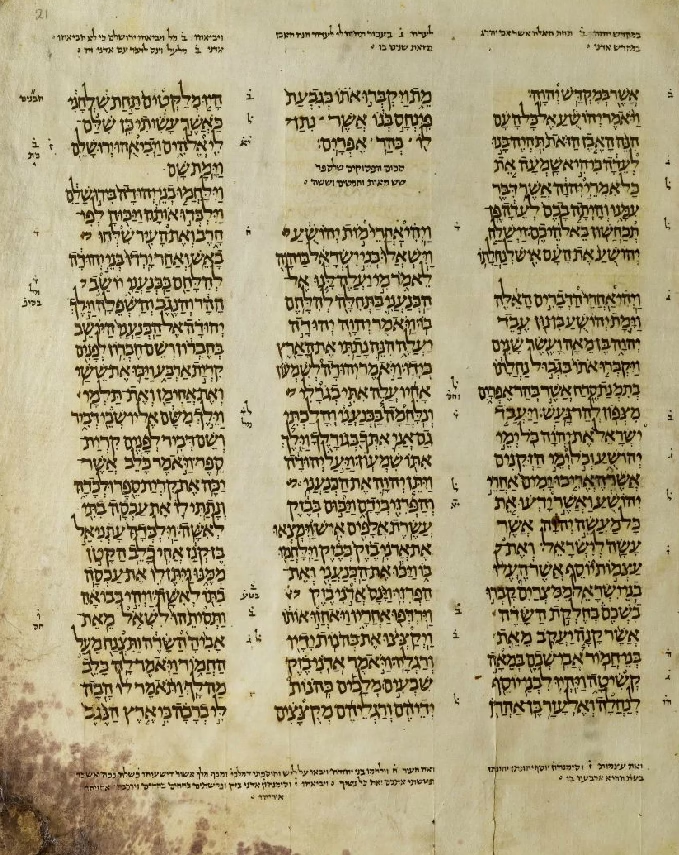
God’s Word Given Through Human Messengers
One of the most common objections to the Christian faith sounds simple but carries weight:
“How can the Bible be the Word of God if it was written by men?”
The Bible itself does not shy away from this question. In fact, it answers it directly. Scripture never claims to be the result of human religious reflection slowly evolving over time. Instead, it presents a clear and consistent claim: God spoke, and He used human messengers to deliver His Word.
As I’ve been studying Scripture more deeply, alongside a theology course focused on the trustworthiness of the Bible from DTS which I highly recommend, it has become evident that what history and theology affirm is exactly what the Bible has always said about itself. The authority of Scripture does not begin with institutions or later explanations; it begins with God.
Scripture Is God-Breathed
2 Timothy 3:16–17
“All Scripture is God-breathed and is useful for teaching, rebuking, correcting and training in righteousness.”
Paul’s statement leaves no room for partial inspiration. All Scripture is theopneustos, breathed out by God. This means the origin of Scripture is divine, not human. The human writers did not originate the message; they transmitted it.
This is the foundation of biblical authority. If Scripture is God-breathed, then it carries God’s authority, not because of who copied it, preserved it, or taught it later, but because of who spoke it.
Human Authors, Divine Direction
2 Peter 1:20–21
“No prophecy of Scripture came about by the prophet’s own interpretation… men spoke from God as they were carried along by the Holy Spirit.”
Peter explicitly rules out private origin. Scripture did not come from human initiative, imagination, or personal insight. The writers were “carried along” by the Holy Spirit. They were active participants, not passive machines, but they were not self-directed.
This is where many misunderstand inspiration. God did not erase personality or style, but He governed the outcome. The message remained exactly what God intended to communicate.
This creates a straight line:
God → revelation → messengers → Scripture
Not a loop of human opinion feeding back into itself.
God Treats Written Scripture as His Own Voice
Joshua 1:8
“This Book of the Law shall not depart from your mouth…”
After Moses’ death, God does not give Joshua new revelation. He points him to what has already been written. Success, obedience, and faithfulness are tied directly to submission to Scripture.
This shows that written Scripture functioned as authoritative from the moment it was given. God Himself treats the written Word as binding.
Words Taught by the Spirit
1 Corinthians 2:13
“We speak not in words taught by human wisdom but in words taught by the Spirit.”
Paul goes beyond ideas. He speaks of Spirit-taught words. Christianity does not rest on abstract spiritual feelings, but on revealed truth communicated through language.
This is why doctrine matters. This is why wording matters. And this is why Scripture cannot be reshaped to fit modern preferences without losing its authority.
Obedience and Recognition of Truth
John 7:17
“If anyone chooses to do God’s will, he will know whether my teaching comes from God…”
Jesus makes a profound statement here: spiritual recognition follows obedience. Scripture is not unclear; hearts are often unwilling.
This explains why Scripture is frequently dismissed, not because it lacks evidence, but because it confronts sin, pride, and autonomy.
Scripture as Covenant Witness
Deuteronomy 31:26
“Take this Book of the Law and place it beside the Ark of the Covenant…”
The Law is placed beside the Ark as a legal witness. Scripture is not inspirational literature; it is covenantal testimony. It holds God’s people accountable.
From the beginning, Scripture functioned as authoritative revelation, not optional religious guidance.
Apostolic Teaching Preserved
2 Thessalonians 2:15
“Stand firm and hold fast to the traditions you were taught, whether by word or by letter.”
Paul refers to apostolic teaching, some spoken, some written. Once the apostles were gone, what remained was the written testimony. Scripture did not gain authority from the church; the church recognized the authority Scripture already had.
Scripture Is True and Settled
Psalm 119:160
“All your words are true; all your righteous laws are eternal.”
Psalm 119:89
“Your word, LORD, is eternal; it stands firm in the heavens.”
Scripture presents itself as settled truth, not evolving religious thought. Before it was written on earth, it was established in heaven.
Revelation Is Not From Man
Galatians 1:11–12
“I did not receive it from any man… I received it by revelation from Jesus Christ.”
Paul completely removes human origin from the equation. The message came from God. Men were messengers, not editors.
Final Conclusion: God Spoke, and His Word Endures
The Bible consistently testifies to one reality:
-
God speaks
-
God appoints messengers
-
God ensures the message
-
God preserves His Word
-
God holds humanity accountable to it
Human authors were not injecting opinions into divine truth. They were faithfully delivering what God revealed.
The Bible is not trustworthy because scholars defend it.
Scholars can defend it because it is trustworthy.
Scripture is not merely a record of faith.
It is the voice of God—spoken through men, preserved by God, and authoritative forever.For further study, I highly recommend this course from DTS which you will find very helpful in learning more.
Related
Discover more from Christ Reigns Media
Subscribe to get the latest posts sent to your email.